A Systems Handbook for Engineers Shipping AI

The engineering reference for shipping LLM systems at scale.

Six governing laws. Fourteen chapters of production-tested techniques. Cut API costs from $11,000/month toward $400, best case near $160, and perceived latency from 17 seconds to under 2.

96–98%
Cost reduction
10x
Latency cut
14
Chapters

324 pages, 7×10 · Or try the calculator first.
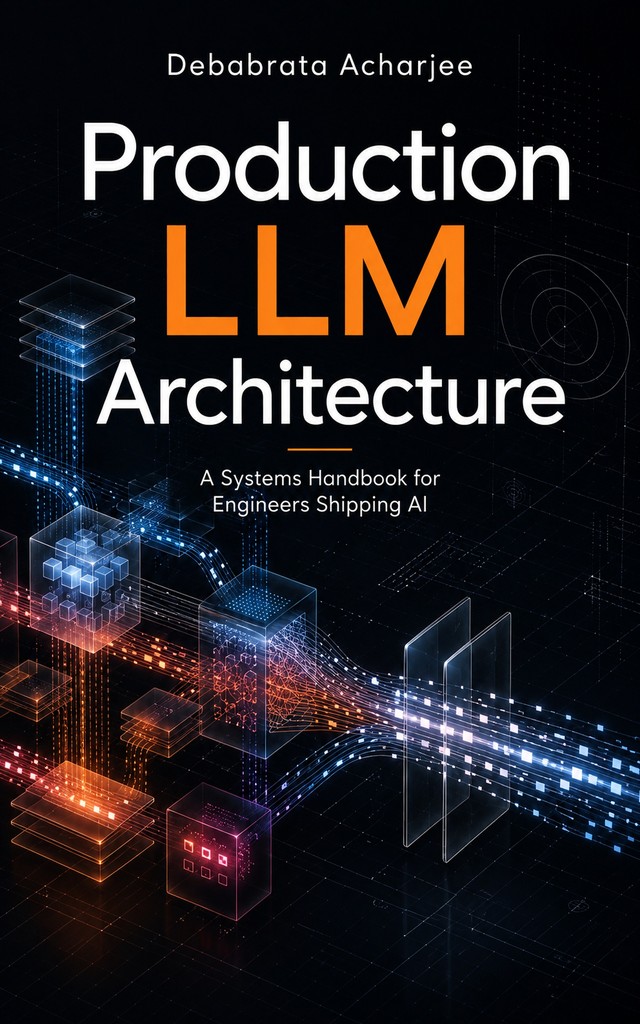
Cover of Production LLM Architecture: A Systems Handbook for Engineers Shipping AI, by Debabrata Acharjee
The Governing Framework

Six Laws of Production LLM Systems

Every chapter in the book references which laws it addresses. Every failure mode is tagged by the law it violates.

LAW 1

The Prefill Law

Input token count determines time-to-first-token.

LAW 2

The Sequential Output Law

Output tokens generate one at a time, and cost roughly 5x input.

LAW 3

The Prefix Stability Law

Cache reuse requires exact token-for-token prefix match.

LAW 4

The Information Density Law

Remove redundancy from context, never structure.

LAW 5

The Routing Law

Match model tier to task difficulty: excess capability is waste.

LAW 6

The Bounded State Law

Context that grows without bounds hits latency and cost walls.

What's Inside

Four parts, ten appendices

Every technique is grounded in production results: what actually breaks at scale, not what looks good in benchmarks.

Part I: Inference Mechanics

How LLM inference works at the hardware level

Prefill and decode, token economics, and how the KV cache creates both the cost problem and its solution.

Part II: Context Architecture

The per-request optimization stack

Data engineering, query-aware filtering, prompt caching, instruction minimalism, and tiered model routing.

Part III: Execution Architecture

System-level concerns at scale

Pipeline orchestration, tool use and agents, evaluation frameworks, retrieval architecture, and guardrails.

Part IV: Deployment & Operations

Shipping and running the full stack

Graduated rollout, production monitoring, cost anomaly detection, and a catalog of 24 documented failure modes.

69
Code samples
106
Data tables
24
Failure modes
10
Appendices
Free Tools

Run the numbers on your own system

Two calculators built from the book's own formulas: no signup required.

What readers are saying

"It's dense in the best way"

"Rather than being another rehash of prompt engineering tips, it's organised around six actual laws that describe how production LLM systems behave […] so by the end you understand why your system behaves the way it does under load, why latency shows up where it does, and why certain routing choices quietly blow your costs up. It's the kind of understanding people usually only get by learning it the hard way, in production, at 2 am.

"I'd point this squarely at senior engineers and tech leads who already have systems running in production and want to get serious about cost and performance instead of guessing at either. It's dense in the best way, so keep a notebook nearby as you read."

Fred Momeni · Senior Software Engineer, Canva · LinkedIn, August 2026

"A Must-Read for Engineers Building AI in Production"

"An excellent and highly practical guide to building production-ready LLM systems. The author has done a fantastic job of simplifying complex architectural concepts and presenting them in a clear, structured, and genuinely useful way. […]

"A very well-written and insightful handbook, and a great resource for anyone serious about building robust AI systems in production. Highly recommended!"

Debbie · ★★★★★ · Amazon review, August 2026

Get the book

Fourteen chapters, ten reference appendices, and 24 documented failure modes: the engineering layer above model selection.

Paperback is 7×10, 324 pages, perfect bound. Both editions sold and shipped by Amazon.